
 Wormy WorldsThe good kind of earworm.
Coming soon to the App Store.
Wormy Worlds: A metronome that helps you trust your ears.
You decide what a good try is. After each one, you answer: YES or NO.
Wormy Worlds is a metronome app for iPhone that works alongside your teacher, not instead of one.
- Choose one small challenge, and decide what a YES is.
- Play it. Answer honestly: YES or NO.
- Reach your goal of more YES than NO, and a world is born.
TestFlight invitations are sent by email, so we need your address. Free to test: TestFlight is Apple's free app for trying apps before they reach the App Store. How to join

Listen honestly. Celebrate every YES. Learn from every NO.
A NO shows you where your attention went: slow down, or make the challenge smaller.
The problem
Practice is often repetition without attention.
We play a passage again and again without noticing what we actually played. We don't know exactly what we're aiming at, or whether we hit it. So practice turns into minutes spent instead of something learned.
And what we repeat is what we learn. Repeat a passage carelessly, and the carelessness becomes the habit. When we can't see progress, it's easy to get discouraged.
Apps that listen to you play and grade you seem to solve this, but they take the judgment away. The machine decides what was good, and the player stops listening for themselves.
The method
Good practice asks a few honest questions.
- What will you focus on?
- Can you tell if you got it?
- Is it hard enough to teach you, and small enough to master?
Wormy turns them into the three steps at the top of this page. Here is what each one asks of you:
- 1 · Choose
Small enough to master, clear enough to judge.
Before you play, decide what success means for this one challenge. For example: “bars 9 to 16, at 132 beats per minute, with no stopping.” You set the bar, or you and your teacher set it together. Wormy never decides it for you.
- 2 · Play and answer
Notice what you really played.
Tap YES if you played what you set out to play, and NO if you didn't. Only you can say: Wormy never hears you play, so it works with any instrument, or your voice. A YES grows a green worm. A NO puts up a red one: it isn't failing, it's noticing where your attention went. Honest answers, try after try, build good habits and real confidence.
Why trust your own answer? Because the honest answer is the practice. A YES you didn't earn teaches you nothing; an honest NO shows you exactly what to work on. Noticing is the skill.
- 3 · Reach the goal
More YES than NO, counted for you.
Your goal is a number, like 5: reach five more YES than NO in total (not five in a row), and a world is born. Each YES counts one, and each NO takes one back. The world is yours to keep, and it lands on a calendar on the day you earned it.
Why YES and NO
When YES comes more often than NO, you're building good habits.

Every try adds to the worms: green for YES, red for NO.
Play what you set out to play more times than not, and it becomes what you do. Confidence grows the same way: from successes you can see, not from being told you're doing fine.
Only YES? It's easy for you now. You'll reach the goal quickly and move on to the next thing.
Only NO? It may be too hard for today. Choose a smaller goal.
A mix of green and red means the challenge is about right: hard enough to teach you, small enough to master.
Who decides
It asks. You listen.
Wormy has no microphone. It never hears you play and never grades you. Whether you're a student, a teacher or any musician, the judgment is yours. Wormy only asks, counts and draws.
That makes it mindful practice. You learn to listen to yourself, notice what you really played, and own the result. At a time when we hand more and more of our thinking to machines, Wormy builds the opposite: attention, honesty with yourself, and a real sense of agency.
And it supports the teacher instead of replacing them. Nothing is judged by a machine, so the teacher stays at the center of the learning.
Students stop seeing the teacher as the judge. They feel free to listen closely and honestly to what they play, and to enjoy it.
For teachers
The lesson becomes a rehearsal of good practice.
Wormy is built for the week between lessons.
You stop being the authority who says yes or no. Together you choose the challenge: what are we working on, and what counts as a YES? Then the student plays, and answers for themselves: did I get it? You guide the process.
It's easy to assume a student knows whether they played what they set out to play. Often they don't, until they're asked. Wormy asks after every try, so they learn to listen and to see what they're really doing, and the progress they can see becomes their own motivation. You no longer have to supply it.
Repetition that would feel like too much becomes a game they want to finish. After a world is born, the app offers one more for good luck, and many students take it: they're glad, and in the zone.
Wormy steps into the relationship rather than replacing it. The lesson becomes a partnership in learning how to practice, and that's what makes it special, and a lot more joyful.
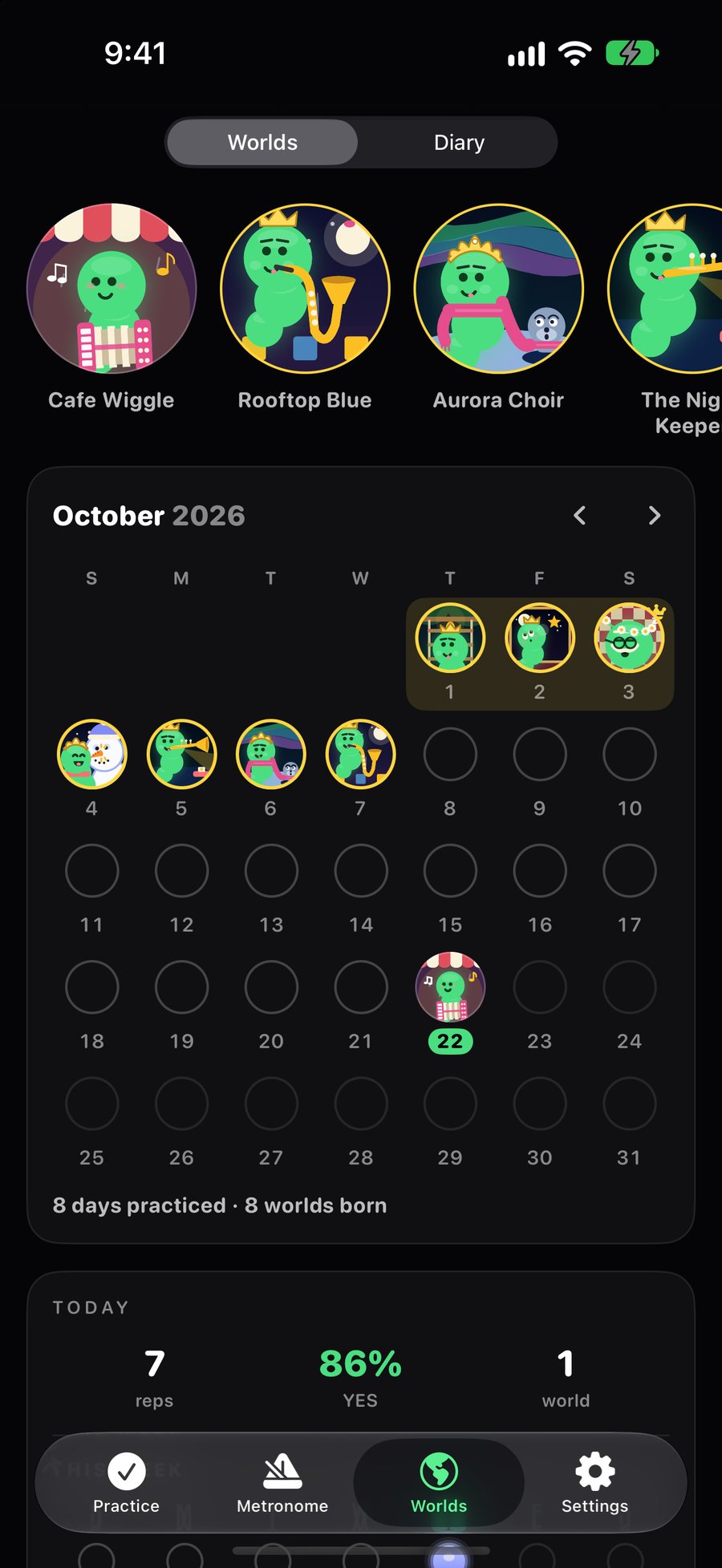
Worlds are the history.
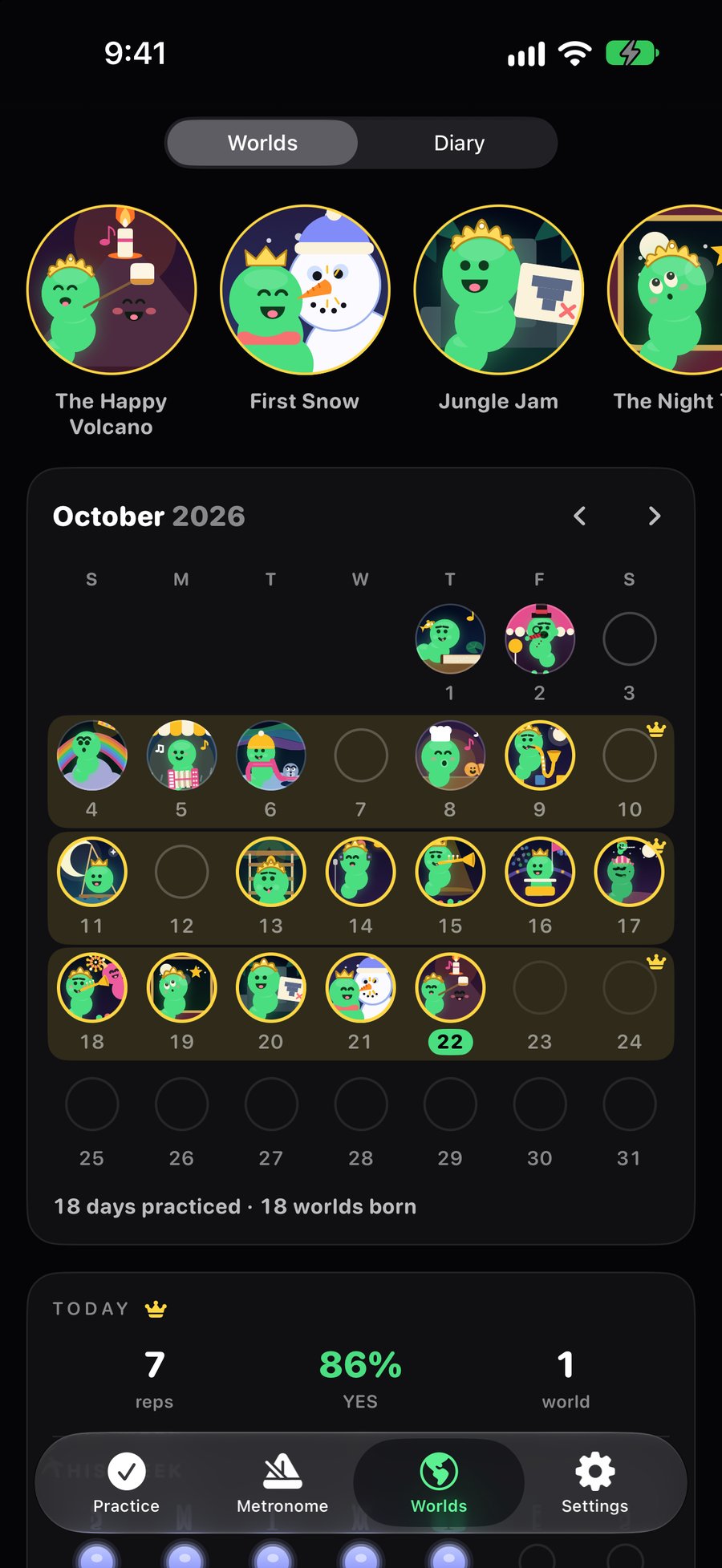
Each world lands on the calendar on the day it was earned. Next lesson, open it together: the days practiced, and what came of them.
The fun part · in the app
Progress you can see.
The Practice screen, step by step:
- Choose the passage and what a YES is. Here: Autumn Leaves, bars 9 to 16, no stopping.
- Set the tempo and the goal. Here the click is at 132 beats per minute, and the goal, +5, means five more YES than NO.
- Play the passage once. Then tap YES if you played what you set out to play, or NO if you didn't.
- Each YES makes the green worm grow. Each NO puts a red worm on the road, so you can see it too.
- The glowing ball at the end of the road is your world. Reach the goal, and it's born.
Story
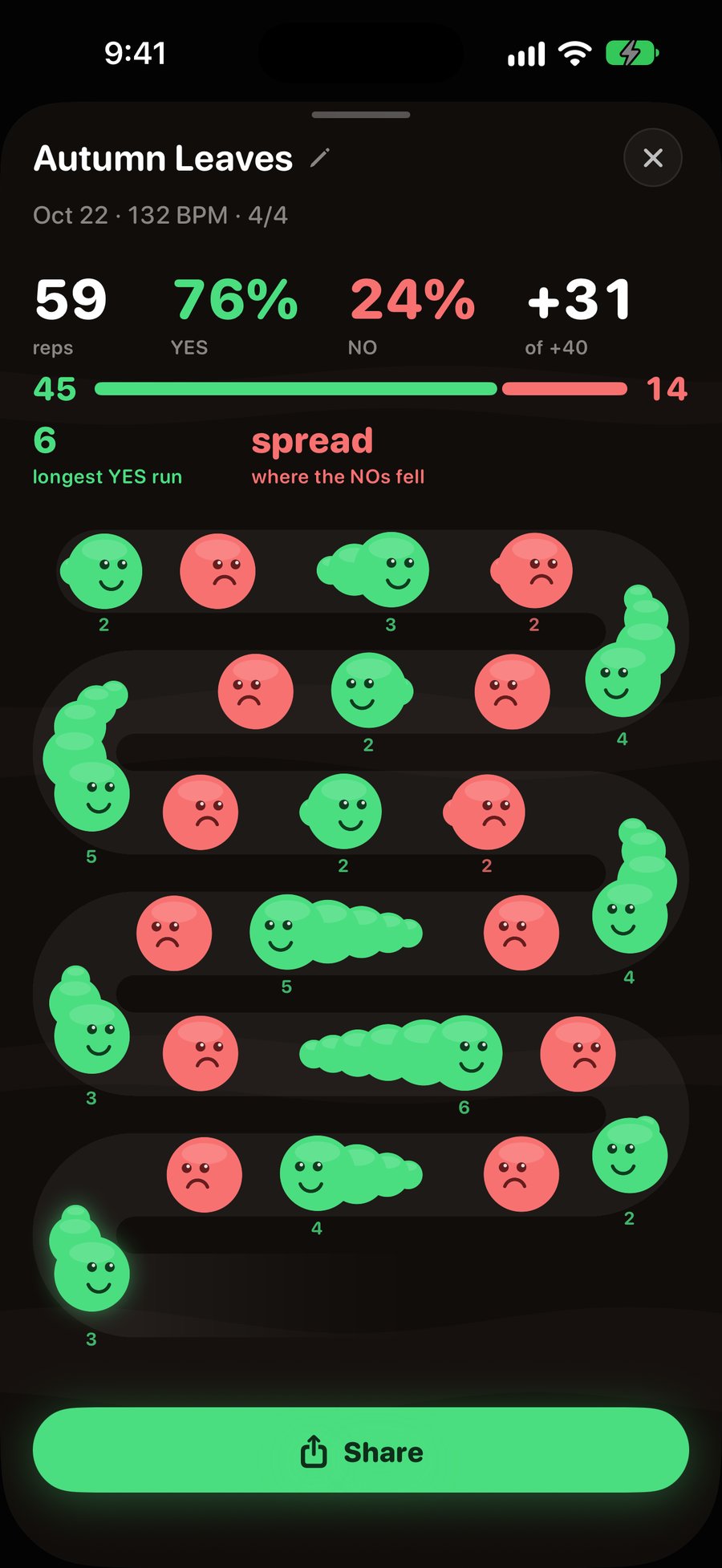
Every try, in order.
The story is about you.
A story is one challenge, from your first try to its world. The story page shows every YES and NO in the order you played them. A run of NO can mean rushing, tension, tiredness, a break that's due, or a goal that's too far.
World
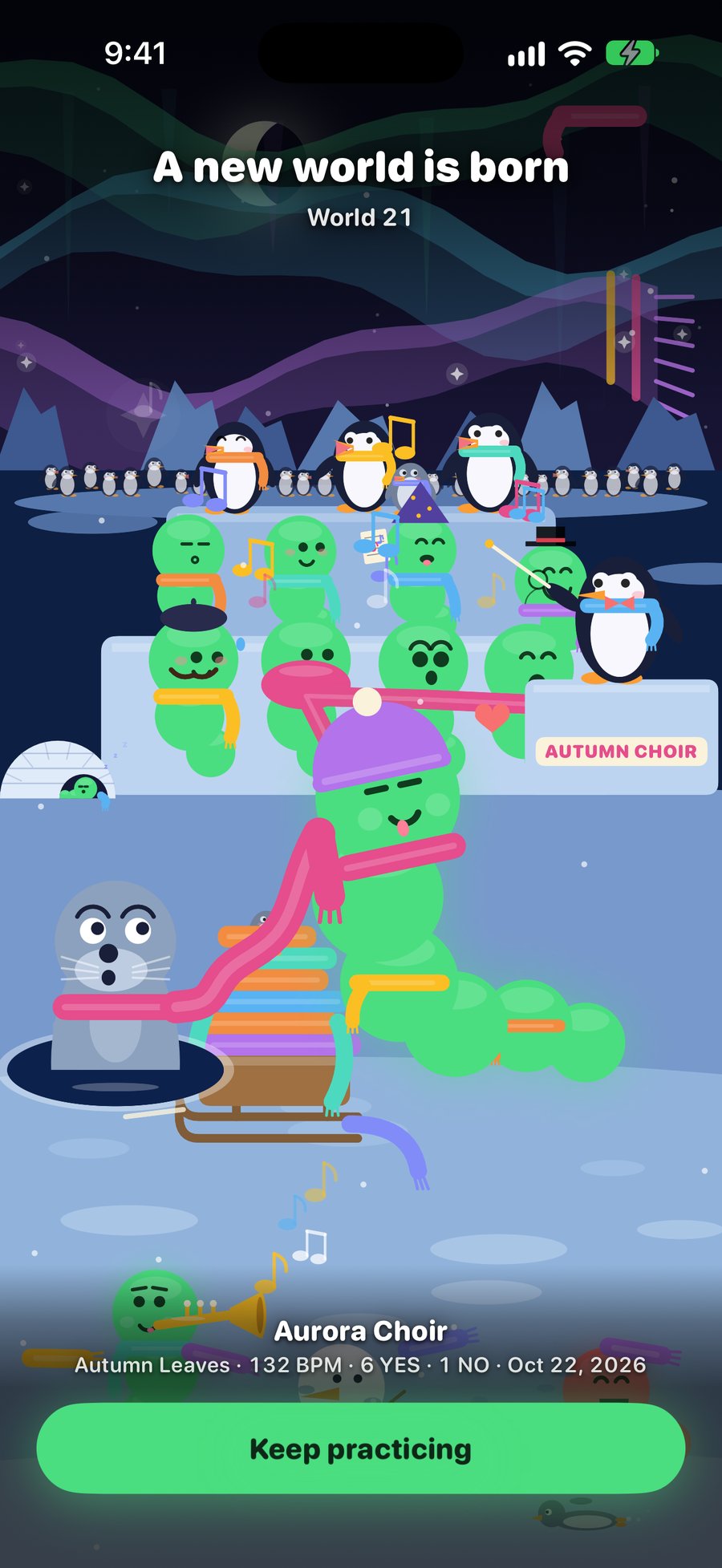
The results of your practice, yours to keep.
Reach your goal and a world is born: a small illustrated scene, one of thirty to collect, each with a little story of its own. It keeps the piece, the tempo and the count, so every world is a keepsake of practice that really happened.
This one: Aurora Choir · Autumn Leaves · 132 BPM · 6 YES · 1 NOThe Tempo Ladder
Earn the next tempo.
Turn on the Tempo Ladder, and each goal you finish offers the next tempo step. The click climbs only as fast as your YES answers earn it.
The step is 4 beats per minute unless you choose another, so 100 becomes 104, then 108. Every tempo becomes one line of the story, so the whole climb is there to see.

A detail, for musicians
Page-turn pedal
Hands free, eyes on the music.
A Bluetooth page-turn pedal, the kind musicians use to turn the pages of sheet music on a tablet, lets you answer without lifting your hands from your instrument. Left is NO, right is YES. No pedal? The big buttons on the screen do the same.
One more thing.
Royal worlds
Practice on five different days in the same week…
…and the worlds you earn are royal.
Practicing on most days is the habit that makes practice work, so Wormy marks it. Do it, and your worm turns gold and wears a crown. Every world you earn while it's crowned is a royal world: a world with a gold rim, and a crowned worm. It's a reward for coming back, not for playing longer.
Try it.
Wormy Worlds is in testing now, and testing is free.
- Ask for an invitation. Write to us, and Apple's TestFlight will send you an invitation by email.
- Get TestFlight. TestFlight is Apple's free app for trying apps before they reach the App Store. It's in the App Store.
- Open the invitation on your iPhone. Tap View in TestFlight, then Accept, then Install. Wormy lands on your Home Screen.
TestFlight invitations are sent by email, so we need your address. For iPhone, iOS 17 or later. Free to test · No account · No ads
Questions or feedback? Write to [email protected]. It’s also at the top of Settings in the app.
Also, if you want it
Prefer to count only YES?
Turn off Count NO, for a hard day or a young student. Then a goal of five means simply five YES, however many NO it takes. Every NO still shows.
Calm
For those who'd rather the app held still: fewer animations and a plainer screen. It turns on by itself when Reduce Motion is on in your iPhone's settings.
Who's holding the phone?
When you first open Wormy, it asks whether you teach, you're a parent, you're learning, or you play, and shapes its introduction for that person.
A full metronome
Underneath it all: 10 to 400 beats per minute, meters up to 16 beats, swing, and nine sounds.